Curriculum design · UT Austin RET
Inventing a sport. Discovering the math.
A ball, a surface, and a question: what makes a good bounce? Students design a new sport and use mathematics to explain their choices.
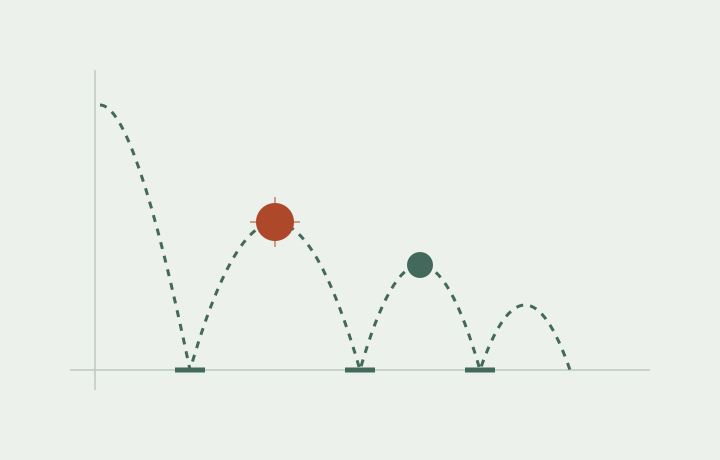
Start with a game worth playing
Students become sports engineers: inventing rules, selecting equipment, and creating a tabletop prototype. Their sport has one essential ingredient—a ball that bounces.
They test different combinations of balls and surfaces, record the motion, and compare the results. Material choices become something they can measure and explain.
Faith’s contribution
Faith co-authored Drop the Ball: Learning About Material Physics, Motion, and Quadratics Through Sport Design with Tanima Mukherjee through UT Austin’s Research Experience for Teachers program.
The published activity brings engineering design and mathematical analysis together. Students use observations from their bounce tests to model motion with quadratic functions, then use that evidence to support their design decisions.
A graph with something to say
The highest point on the graph becomes the top of a bounce. The points where the ball meets the surface give meaning to the intercepts. The equation describes an event students have just watched.
An optional calculus extension connects the same motion to position, velocity, acceleration, and derivatives—another way to connect the model to the physical world.
Published work
Try the complete activity
The published lesson includes project worksheets, assessment rubrics, and a calculus extension.
Read Drop the BallCurriculum contributors: Tanima Mukherjee and Faith Palombi.